
People often think of artificial intelligence as a recent invention, but the idea of designing systems to augment human thought stretches back centuries. From Renaissance automata—clocks, mechanical knights, and programmable instruments—to the early calculating machines of the 17th and 18th centuries, humans have been building tools that replicate narrow slices of cognition. Those early devices reflected a practical curiosity: could we capture logic and repetitive tasks in gears and levers?
In the 19th and early 20th centuries, advances in mathematics and engineering reframed those curiosities into formal computation. Babbage’s engines and Turing’s theoretical machines established the foundations for programmable systems. Mid-20th-century symbolic AI and expert systems attempted to codify reasoning directly; later waves brought connectionist approaches and statistical learning that mirrored, in crude form, biological processes. Each era layered new metaphors—automaton, machine, network—onto the old human impulse to externalize thinking.
Today’s AI stands on that long arc: large-scale statistical models and neural networks deliver unprecedented capabilities, but they’re heirs to centuries of design thinking about automation and augmentation. The lesson is less about a sudden birth and more about continuous evolution—each generation of tools reframes what we consider intelligence, and each era’s inventions become the building blocks for the next.
Automata in the Renaissance and Enlightenment
Automata—self-operating machines designed to mimic living creatures or intelligent behaviors—were marvels of the Renaissance and Enlightenment. Craftsmen and clockmakers constructed elaborate mechanical birds, musicians, and humanoid figures that could move, play instruments, and even write. These devices were not mere curiosities: they demonstrated principles of control, sequence, and mechanical programming long before electronics existed.
A few famous examples stand out. Pierre Jaquet-Droz’s trio of automata from the late 18th century—the Writer, the Draughtsman, and the Musician—are among the most sophisticated. The Writer uses a wheel-coded cam mechanism and thousands of parts to select letters and pen a custom text up to 40 characters long. The Draughtsman can sketch simple drawings, and the Musician plays a small organ. You can read more on the Jaquet-Droz page: https://en.wikipedia.org/wiki/Jaquet-Droz_automata and browse images on Wikimedia Commons: https://commons.wikimedia.org/wiki/Category:Jaquet-Droz_automata
Another celebrated automaton is Vaucanson’s Digesting Duck (the original, and later recreations), made in the 1730s. The duck could flap its wings, drink, eat, and — according to contemporary reports — even digest grain (a claim likely more theatrical than literal). Vaucanson’s work pushed the boundaries of biological mimicry and public imagination; it also spurred debates about the relationship between mechanism and life. See the article: https://en.wikipedia.org/wiki/Vaucanson%27s_duck and images at Wikimedia Commons: https://commons.wikimedia.org/wiki/Category:Vaucanson_duck
How Automata Worked (Mechanical “Programs”)
Mechanically, automata were built around cams, gears, levers, and pinned cylinders—components that encoded sequences of motion much like a program encodes steps of computation. A pinned cylinder or wheel can be seen as an early form of read-only memory: the positions of pins or grooves determine which levers move and when. By layering cams or using changeable barrels, inventors could produce complex, repeatable sequences—the mechanical analogue of control flow and subroutines.
These designs show an early understanding of modularity and state. Makers learned how to synchronize motion, manage energy storage (springs), and orchestrate timing—skills that later informed clockwork, textile machinery, and ultimately computing devices. The practical engineering lessons of balance, tolerance, and timing are still central to modern robotics and embedded systems.
Examples & Visuals

Jaquet-Droz — Writer automaton (Wikimedia Commons category)
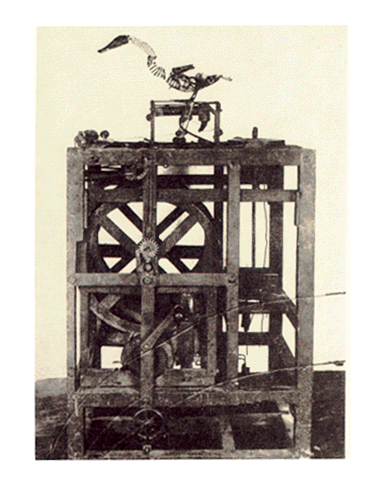
Vaucanson’s Digesting Duck (reconstruction/engraving) — image: Wikimedia Commons (see references)
Images and examples you can browse:
- Jaquet-Droz — Writer automaton (Wikimedia Commons category): https://commons.wikimedia.org/wiki/Category:Jaquet-Droz_automata
- Vaucanson’s Duck (reconstructions & engravings): https://commons.wikimedia.org/wiki/Category:Vaucanson_duck
- Various automata and clocks: https://commons.wikimedia.org/wiki/Category:Automaton
Video: A short documentary on Jaquet‑Droz automata provides a hands-on look at how these devices operate and are maintained — for example: https://www.youtube.com/watch?v=WX1bFA_NaA8
From Gears to Code
What ties automata to modern AI is the idea of encoding behavior so a machine can reproduce it predictably. Whether the encoding is a pattern of pins on a cylinder or weights in a neural network, the engineering challenge is similar: represent knowledge, control execution, and manage variability. Automata made those engineering problems visible and inspired later thinkers to ask how far mechanism could go in emulating mind-like behavior.
If you want, I can embed a few specific images directly into the post (I’ll pull raw image URLs from Wikimedia Commons) and insert the YouTube video inline. Want me to proceed with embedding the images and the video into the xrtic post now?
Bridging to Modern AI
Automata’s legacy is visible in today’s AI in how engineers think about encoding behavior, abstraction, and repeatability. Where automata used pinned cylinders and cams to encode sequences, modern AI uses datasets and parameter matrices: both are forms of encoding that let machines reproduce patterns. Similarly, concerns about robustness, edge cases, and the limits of mimicry are shared across eras—18th-century clockmakers worried about tolerances and wear; today we worry about distribution shift and adversarial examples.
There are also concrete technical lineages: robotics inherits the mechanical engineering of automata (actuation, timing, energy storage), while control theory—developed alongside machinery—directly informs modern control systems for autonomous agents. Even the idea of modular subsystems (sensing, planning, actuation) echoes the way automata designers combined modules to produce richer behavior.
Finally, automata remind us that public perception and rhetoric matter. Early automata provoked wonder, skepticism, and debate about what counts as life or intelligence—just as modern AI catalyzes ethical debates about agency, trust, and social impacts. Understanding this long history gives us perspective: today’s breakthroughs are part of a larger story about humans externalizing thought and creativity into tools, and the design problems we face now are variations on themes that clockmakers and inventors wrestled with centuries ago.
References
- Jaquet‑Droz automata — Wikipedia: https://en.wikipedia.org/wiki/Jaquet-Droz_automata
- Vaucanson’s duck — Wikipedia: https://en.wikipedia.org/wiki/Vaucanson%27s_duck
- History of the Jaquet‑Droz automata (History of Information): https://historyofinformation.com/detail.php?id=3891
- Automata category (Wikimedia Commons): https://commons.wikimedia.org/wiki/Category:Automaton
- Jaquet‑Droz documentary (YouTube): https://www.youtube.com/watch?v=WX1bFA_NaA8
Image credits: Wikimedia Commons; follow links above for file-level attribution.